Llevar a tu bebé a nadar: La guía completa para padres

Planning a trip to the pool with your little one and wondering when you can take a baby swimming? The short answer is from birth. Thousands of families take their babies swimming each year, and it's a lovely way to get out of the house and spend time together.
Estimated reading time 12 minutes
Whether you're a first-time parent or you've just had your fifth, you might have a few questions if you're new to baby swimming. We invented the Happy Nappy™ in 2005 and have spent the years since working with swim schools on exactly these questions, so we're going to answer them for you below.
When Can You Take a Baby Swimming?
Babies can enjoy the pool from birth. There's no minimum age, and no medical reason to hold a healthy baby back once you've found water warm enough for them. What changes as they grow is the temperature they need and how long they'll enjoy it, so you can go at whatever pace feels right for you both.

Can I Take My Newborn Swimming?
Yes. A healthy newborn can go in the pool, provided the water is heated to around 32°C, because babies this small lose heat far faster than you do. That usually means a specialist baby pool or a hydrotherapy pool rather than the main pool at your leisure centre.
If your baby was born premature or has a health condition, check with your GP or health visitor first. They know your baby's history, so their advice comes before any general rule, including ours.
Can I Take My 2, 3 or 4 Month Old in a Swimming Pool?
Yes, and this is the age a lot of families start. Up to three months, or until your baby weighs about 12lb, they still need that 32°C water. After that, a pool of at least 30°C is fine, which opens up many more learner pools and parent and baby sessions.
Dipping their feet in first is a gentle way to start at any of these ages. Plenty of babies are happy to kick on the step for the whole of their first visit, and that counts as a lovely first swim.
When Can Mum Go Swimming After Giving Birth?
According to medical experts, if you've given birth, you should wait seven days after bleeding has ended. This is to reduce the risk of infection. If you've had a caesarean section or a perineal tear, you might need to wait longer. That's completely normal. Discuss this with your GP or health visitor during postnatal check-ups.
Of course, dads, grandparents and other caregivers can take baby swimming sooner!

What Age Do Baby Swimming Classes Start?
If you're planning to join a class, you'll find some classes set a minimum age of six weeks, while others take babies from birth in specially heated pools. Ask before you book, and ask what nappy they require at the same time, because most schools have a rule on that too.
Why Take Your Baby Swimming?
It's one of the few activities you can share with your baby from the very first weeks. Swim England highlights early water confidence as one of the clearest benefits, along with stronger muscles and better balance and coordination as babies work to hold their position in the water. Held close to you, your baby can kick, stretch and move freely long before they can crawl.
It's good for you too. A regular swim gives you both a little routine and a reason to get out of the house, and at a class there are other parents to chat to. Many parents notice their baby sleeps well on swimming days, and a hungry baby afterwards is almost guaranteed.
Most of all, that early confidence is the first step towards learning to swim. It's a life skill that keeps children safer around water as they grow, and it starts with relaxed, happy splashing in a warm pool with you.

Does My Baby Need Vaccinations Before Swimming?
No. According to the NHS, it's safe to take baby swimming from birth, and there's no need for them to be vaccinated before they hit the pool.
Some pools still tell parents to wait for the jabs, so if you've heard that, you can set the worry aside: the advice is out of date. The one sensible pause is straight after a vaccination. If your baby is feverish or grizzly for a day or two afterwards, give them some extra cuddles at home and go next week instead.
Is Chlorine Safe for a Young Baby?
In a properly maintained public pool, yes. Chlorine is what keeps the water safe to share, which is why pools test the water regularly through the day.
It can dry out delicate skin, though. Rinse your baby in fresh water after the swim and moisturise, and if your baby has eczema, ask your health visitor whether to use a barrier cream before you go.
What If My Baby Swallows Pool Water?
A small gulp is very common and usually nothing to worry about, even though it can make your heart jump the first time. Most babies cough or splutter it straight back out, then carry on kicking.
What you shouldn't do is put your baby's head under the water on purpose unless a qualified baby swimming teacher is guiding you. If your baby keeps coughing, struggles to breathe or seems unusually drowsy after a swim, get medical advice straight away.
How Warm Should the Pool Be for a Baby?
Warmer than most parents expect. Baby swimming guidance from the Swimming Teachers' Association puts the water at 32°C for babies under three months or under 5.5kg (about 12lb), and no baby session should run in water below 30°C.
| Your baby | Water temperature to look for | Where you'll usually find it |
|---|---|---|
| Under 3 months or under 12lb | 32°C | Specialist baby pools, hydrotherapy pools |
| Over 3 months and over 12lb | At least 30°C | Learner and teaching pools, baby swim classes |
| Any age, in cooler water | Below 30°C | Main pools: add a baby wetsuit and keep it short |
Most large, public swimming pools are cooler than 32 degrees, and pools set up for lane swimming often sit nearer 28°C. You can always ask an attendant to check the pool's temperature if you're unsure.
How Do I Keep My Baby Warm in the Water?
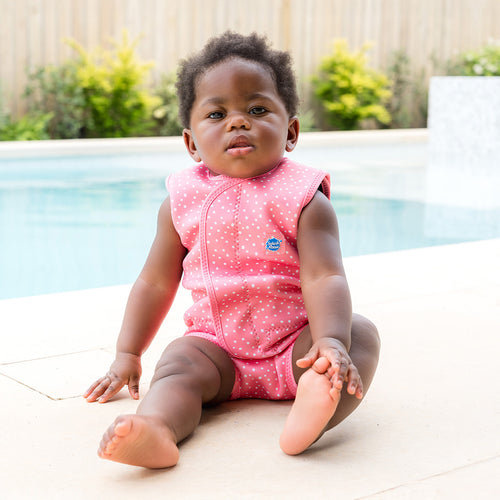
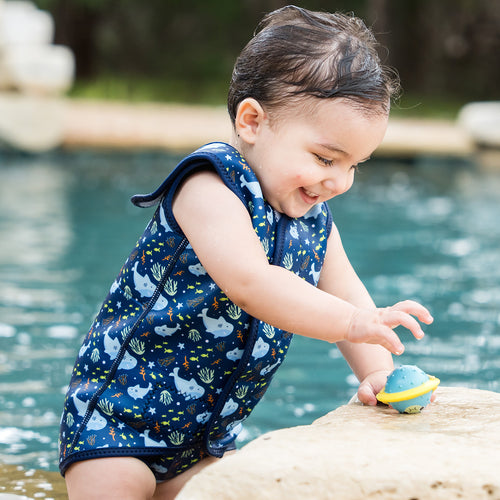
Consider investing in a neoprene baby wetsuit if you're planning to visit a pool that's cooler than 30 to 32 degrees. Our Baby Wrap™ is 2mm neoprene that opens out flat, so you can lay your baby on it and wrap it round them rather than wrestling arms into sleeves. The Warm In One™ does the same job as a one-piece.
Thermal swimwear such as our Thermaswim Baby & Toddler Suits is the other option. Don't use it in hydrotherapy pools or any water above 32°C, where your baby could overheat, and remember that Thermaswim doesn't have a Happy Nappy™ built in, so your baby still needs one underneath.

What If My Baby Starts to Get Cold?
Babies can't control their temperature as well as adults can, so keep a close eye on them. Very young babies may not shiver much at all, so look at their lips and skin too: blue-tinged lips or pale, mottled skin are your signals.
If they start to look cold or shiver, remove them from the pool and wrap them up snugly, however short the swim has been. A Poncho Towel with a hood saves you a minute here, because it goes over their head and keeps them covered while you sort yourself out.
How Long Should Baby Be in the Water For?
You might find your baby can only manage 10 to 15 minutes in the water at first, especially if they're very young. Swimming in a pool will be a new experience for your baby. Besides the water, they'll find the noise, colours and splashing overwhelming too.
It's best to start with short sessions and build up their tolerance, working towards 20 or 30 minutes over the following weeks. Follow your baby's lead, because a short, happy swim does more for their confidence than a long, tired one.
How Can I Get My Baby Used to the Water?
Do familiarise your baby with water at bathtime. Don't submerge them in the tub, but do get them used to the sensation of water trickling down their face.
At the pool, rather than carrying your baby down slippery steps, sit them on a changing mat at the edge, get into the water yourself, then lift them in. Slowly lower baby into the water up to their shoulders, keep eye contact and keep talking. Your face and voice are the most familiar things in a very new place.

Can Babies Hold Their Breath Underwater?
Briefly, yes. Young babies have a natural breath-holding reflex: when water touches their face, they automatically hold their breath. It's strongest in the first few months and fades from around six months.
That reflex doesn't make a baby safe underwater, though. It only lasts a few seconds, it won't always stop them swallowing water, and a young baby can't lift their own head to breathe. So going under is something to do only with a qualified baby swimming teacher, who'll use a simple spoken cue so your baby knows what's coming and will keep a baby who's tired, crying or unsure on the surface. Look for a teacher with a recognised baby swimming qualification from Swim England or the Swimming Teachers' Association.
What Should My Baby Wear Swimming?
All babies will need to wear a swimming nappy (assuming they're not potty trained) in the pool. This is usually a requirement of attending classes, and it's the one piece of kit you can't swap for something you already own.
Why Won't a Regular Nappy Work in the Pool?
A standard nappy is built to absorb, and in a pool that's the problem. It soaks up water from the surrounding water, swells, becomes heavy and pulls down. That makes it uncomfortable for your baby and unsafe in the water.
A swim nappy doesn't absorb water. It's designed to contain faeces with a snug fit at the waist and thighs, so your baby stays comfortable and the pool stays clean.
Can My Baby Swim in Just a Swim Nappy?
Yes, as long as it's the right one for the pool. For a family swim, a well-fitted reusable swim nappy is enough at most pools. Many baby swim schools ask for a double layer, which means an under nappy such as our Size Adjustable Under Nappy with a neoprene swim nappy over the top.
That's why we designed the Happy Nappy Duo™ with both layers in one. Its anti-microbial silver under layer does the under nappy's job, so swim schools that approve the Happy Nappy™ accept the Duo on its own.
Does a Swimming Nappy Hold In Urine?
No. Swim nappies are designed to contain faeces, not wee, and that's the same for every swim nappy on the market. It's one of the questions parents ask us most often. They don't hold in urine, so change your baby into a regular nappy as soon as they come out of the water.
Disposable or Reusable Swim Nappies?
You can get two types of swimming nappies: disposable and reusable. Disposable swim nappies are like regular nappies, and they're thrown away after each use. Reusable swim nappies can be worn multiple times. They're an eco-friendly option, less likely to leak and can save you money in the long run.
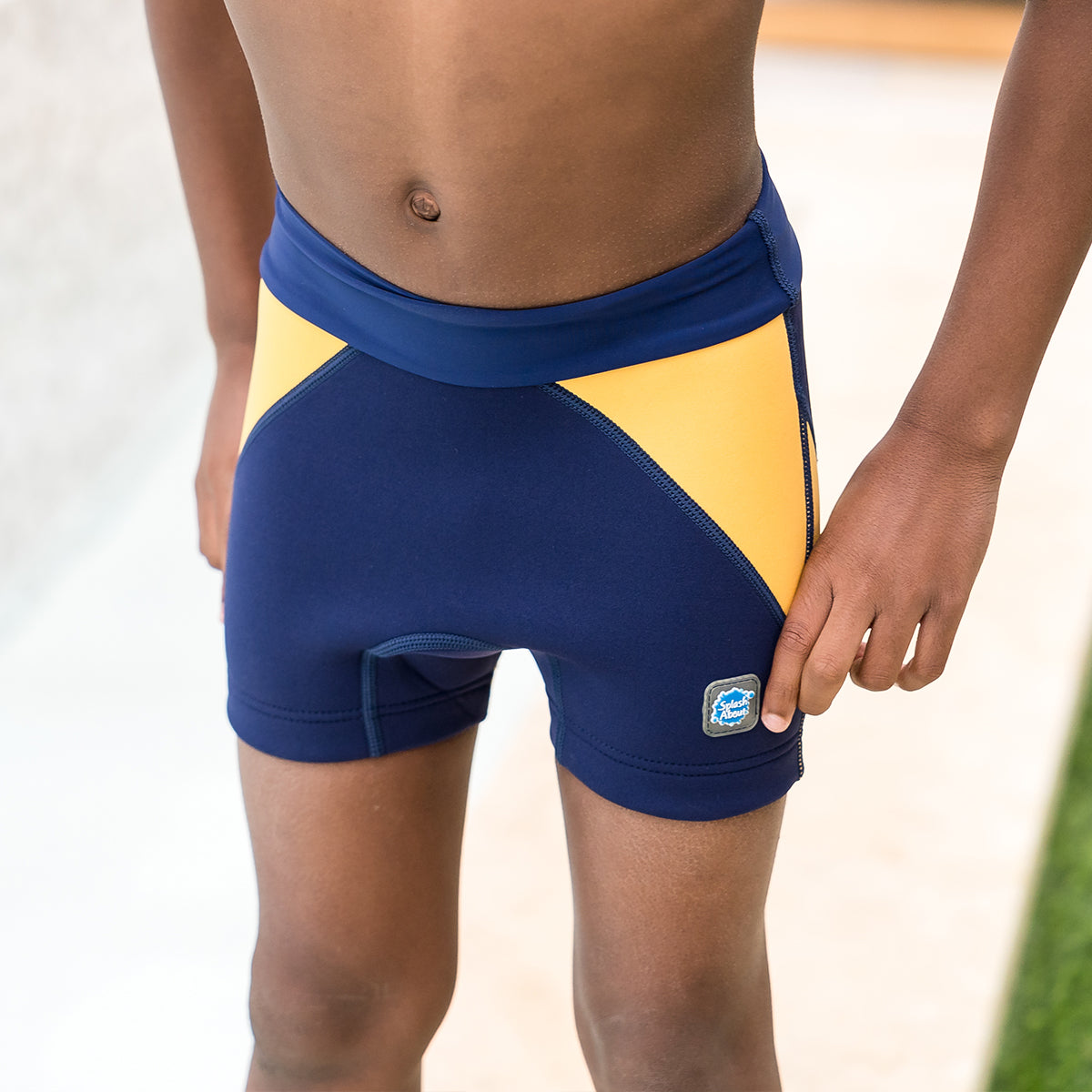
The Happy Nappy™ is our original reusable swim nappy, with soft neoprene and tummy and thigh cuffs that seal without leaving deep red marks. 90% of UK swim schools insist on the Happy Nappy™ or a Happy Nappy™ product, so if you're booking lessons, it's the nappy most likely to be on the kit list. Check the size guide before you order, because fit is what does the containing.
Will I Need to Buy Baby Swim Floats or Other Equipment?
If you're attending a class, the teacher will let you know if any additional equipment is needed. In those early months, your arms are all the support your baby needs.
Once your little one is a bit older and you're swimming at a leisure centre, you might want to invest in a Float Jacket or Floatsuit. Our Learn to Swim range includes:
- The 16-piece Floatsuit, available from 1 year, where the floats can be removed in pairs as your child gains confidence in the water.
- The 8-piece Float Jacket, for ages 1 to 6, which is excellent at positioning children in the correct learn to swim position.
Remember: they're great for added peace of mind, but you must not rely on them to keep your child safe. They will not protect your child against drowning. Only use them when your child is within reach and under constant supervision.

What Do I Need to Take to a Baby Swimming Session?
Alongside a swim nappy, here's what to pack for a swim or a lesson:
A changing mat: our Changing Mat will keep baby away from cold and dirty changing room floors.
Swim toys: our Pufferfish Splash Balls and Splash Mirrors can be used as the perfect distraction for babies who are nervous in the water.
An extra towel: one for you and one for baby when changing, which will prevent anyone getting cold after swimming.
A regular nappy and dry clothes: for the moment they're out, because the swim nappy won't hold wee on the walk to the changing room.
A feed or snack for afterwards: swimming makes babies hungry.
A warm hat: little heads lose heat quickly once they're out of the water.
Your own swimwear: wear it under your clothes and you'll only have one person to change at the pool.
A wet bag: our Wet Bags keep soggy swimwear away from everything else in the changing bag.
If the walk back to the car is a cold one, a Waterproof Splash Suit over their clothes keeps a freshly swum baby warm and dry on the way home.
When Is the Best Time to Take Baby Swimming?
It's best to plan around feeding times. Take baby swimming when they're starving hungry and they'll cry. Take them too soon after a feed, and they may be too sleepy or uncomfortable. A feed about half an hour before you get in is a good middle ground for most babies.
Before you go, do a little research. Find out what facilities the pool has, such as a family changing room and somewhere safe to put your baby down while you get dressed. Then make a plan. Quieter parent and baby sessions are usually calmer and warmer than a busy public swim, so check the timetable too.

When Should You Keep Your Baby Out of the Pool?
When your baby is poorly, the pool can wait until they're feeling themselves again. Skip it if they have a temperature, if they're feverish or irritable after a vaccination, or if they simply seem under the weather.
Diarrhoea is the exception with a longer rule. Some stomach bugs, cryptosporidium in particular, can survive normal pool chlorine, so UK public health guidance is to stay out of the pool until your baby has been clear of diarrhoea for two weeks. It's the same reason pools are strict about swim nappies: one leak can close a pool for everyone.
Resources
We put this guide together using trustworthy sources, including the NHS and Swim England. We recommend you carry out further research into baby swimming, particularly regarding safety. Here are some recommended resources:
- National Childbirth Trust: guide to taking your baby swimming for the first time.
- Swim England: the benefits of baby swimming.
There's no wrong answer to when you can take a baby swimming, as long as the water's warm and you both feel ready. The first swim doesn't need to go perfectly. A few minutes of splashing and a cuddle in a warm towel afterwards is a wonderful start.
If you're not sure which swim nappy or size your baby needs, browse our Happy Nappy™ range or get in touch with our team and we'll happily help you find the right fit for your little one.