
A Parent's Guide to Swimming Lesson Stages: What to Expect at Every Level
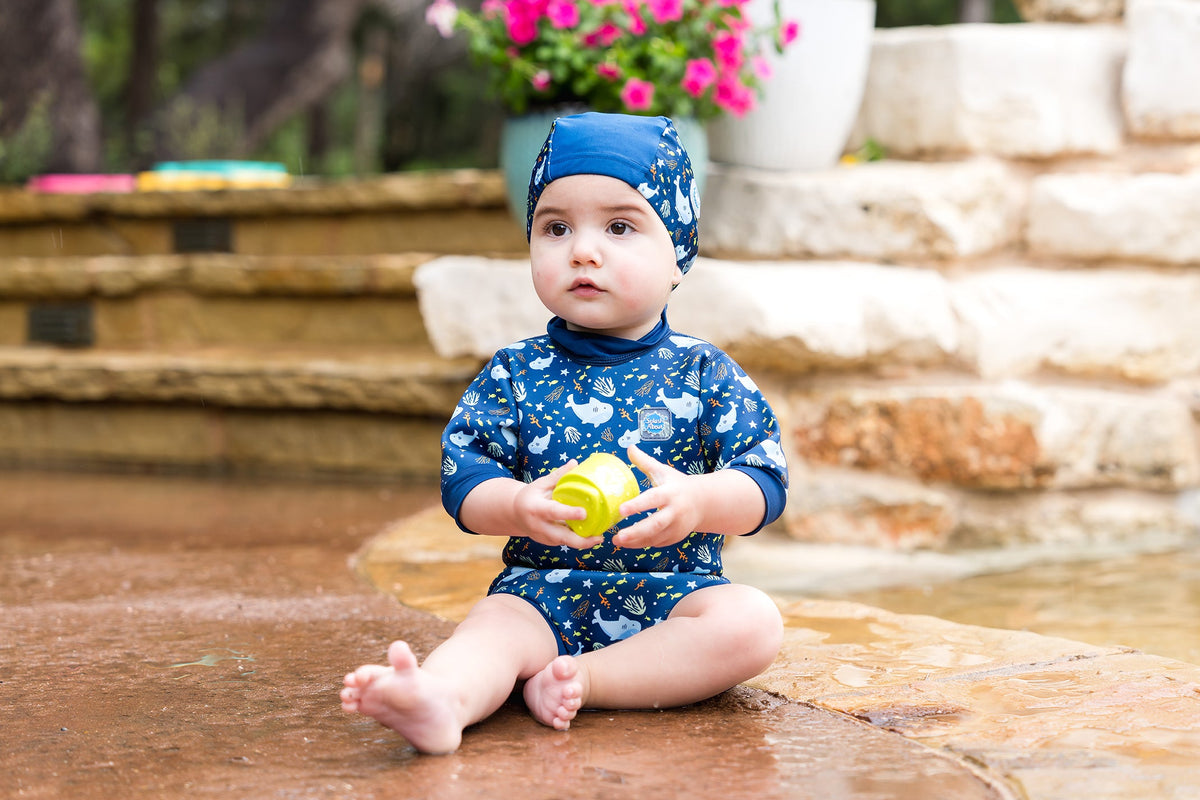
Every parent asks the same question sooner or later: is my child doing okay? Stand poolside for a few weeks and you'll see it for yourself. One child, aged three, is still blowing bubbles at the rail. The child next to them, barely four, swims a width unaided. But that gap isn't a worry, and it doesn't mean you're doing anything wrong. It's the swimming lesson stages doing exactly what they're built to do, and most swim schools in England teach against the same Swim England framework, whether or not it says so on the certificate. So knowing the shape of it should take some of the guesswork out of poolside Saturdays: it tells you what your child is working towards and roughly when to expect it.
- What Are the Swimming Lesson Stages?
- Pre-School Swimming Comes Before Stage One
- Stages One to Three Build Water Confidence
- What Changes From Stage Four Onwards?
- How Long Does It Take to Get Through the Stages?
- What Comes After Stage Seven?
- Floatsuits and Float Jackets Solve Different Problems
- Kickboards and Floats Have Their Own Job
- What If Progress Feels Slower Than Expected?
What Are the Swimming Lesson Stages?
Swim England is the national governing body for swimming in England. It sets out four frameworks that shape most swimming lessons here. Of the two million people learning to swim in England, 1.77 million are learning on the Swim England Learn to Swim Programme specifically, across private swim schools, leisure centres and clubs. There's a Pre-School Framework for babies and toddlers, the Learn to Swim Framework covering Stages 1 to 7, an Aquatic Skills Framework for Stages 8 to 10 and a separate framework for adults.
Each of the seven core stages has a clear list of outcomes a child needs to complete. Your child moves up only once a teacher has seen them repeat a skill reliably, not just get lucky once. If your child's certificate says Stage 3 or Stage 6, this is the framework it's measuring them against.

Your child moves up only once a teacher has seen them repeat a skill reliably, not just get lucky once.
”Pre-School Swimming Comes Before Stage One
Your baby or toddler starts on the Pre-School Framework, which covers the 0 to 5 age range. It aims to build comfort in the water, long before any stroke work begins, and it's every bit as much about you as it is about them. The early awards reward things most parents would recognise as small wins, the kind worth a proper cheer at the poolside:
Entering the water safely and getting used to water on the face
Blowing bubbles, and floating on the front and back with support
Jumping in and moving on their own, with an adult close by
None of it looks like swimming yet. It isn't meant to.
”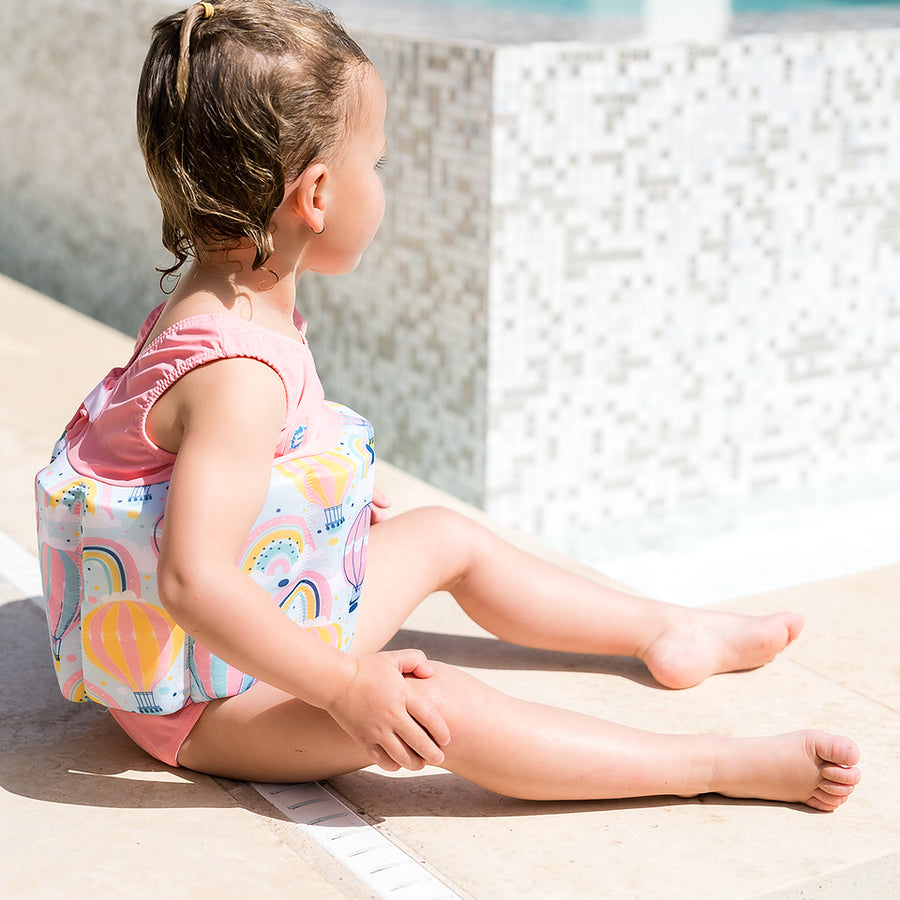
When Can My Child Start Wearing a Floatsuit?
Most children can wear a Floatsuit from around one year old, once they can hold their own head up and support their own neck. The suit's float system, 16 pieces in total, tips your child slightly forward, shoulders under the water: that's the position swimming actually happens in, not the upright bob a rubber ring encourages. You can remove floats in pairs as confidence grows, so the same suit carries your child through several stages.
Worth saying plainly: a Floatsuit is a buoyancy aid, not a device that saves lives on its own, and you need to watch your child constantly whenever they're wearing one.
Swim Nappies Still Matter at This Stage
Pools generally require a swim nappy for any child who isn't yet potty trained, and you can typically stop once they are. Some children need one for longer, whether that's because potty training takes a little longer, a local pool sets its own age rule regardless of training or a child needs ongoing incontinence support. Most swim nappies are sized for children up to around three. A regular nappy won't do the job. It absorbs pool water and drags down instead of protecting anyone.
Swim teachers notice the difference a proper one makes. Rose Cholewinski, who owns Swim America Davis in the US, has said that requiring the Happy Nappy™ for under-fours cut how often her classes had to stop for an accident in the pool. Our Swim Nappy Guide covers how a proper swim nappy works and what to expect at a first lesson. It includes the detail that catches most new parents out: a swim nappy doesn't hold in urine, and it was never designed to.
Stages One to Three Build Water Confidence
Once formal lessons start, Stages 1 to 3 build the basics rather than the strokes themselves. Your child learns to enter the water safely, get comfortable with water on the face, and move without their feet on the floor using a proper leg kick. Somewhere in there, breathing underwater gets introduced too, alongside safe entries such as jumping in. By the end of Stage 3, most children can push and glide with real control and travel up to 10 metres on the front and back, submerging along the way rather than skirting round it.
What Changes From Stage Four Onwards?
Stage 4 works differently from what a lot of parents expect. Rather than learning one stroke at a time, your child develops the leg kick for front crawl, backstroke, breaststroke and butterfly together, alongside a first introduction to sculling and how buoyancy works. The distances build from there through Stages 5 to 7. By the end of Stage 7, most children can manage up to 100 metres using at least three different strokes.
Along the way through the later stages they also pick up treading water, safe jumps into deep water, and knowing what to do if someone else gets into trouble.

How Long Does It Take to Get Through the Stages?
There's no fixed timeline, and any swim school promising one is guessing. Swim England is explicit about this itself. Children need to show they can repeat a skill more than once before a teacher moves them on, so pace depends entirely on the child rather than the calendar, and that's genuinely a good thing: it means your child only moves on when they're actually ready, not because a term has ended. However, how often your child goes still matters more than most parents assume. Lessons missed for holidays or illness mean skills have to be relearned rather than built on, which is a large part of why some children plateau on a stage for a spell before a run of steady weeks moves them on quickly.
There's no fixed timeline, and any swim school promising one is guessing.
”What Comes After Stage Seven?
Once Stage 7 is done, children who want to keep going can move on to the Aquatic Skills Framework, Stages 8 to 10. This stops being about learning to swim and starts pointing towards a specific sport: competitive swimming, water polo, artistic swimming or diving, with rookie lifesaving and snorkelling available through partner awards too. Not every child moves through all ten stages, and Swim England says as much itself. Some children won't complete every stage, and that's a normal outcome rather than a failure.
Floatsuits and Float Jackets Solve Different Problems

A Float Jacket and a Floatsuit both use adjustable buoyancy, but they're not interchangeable. The Floatsuit doubles as swimwear, worn on its own with no separate costume needed, which suits younger children in regular lessons. A Float Jacket goes on over a costume and usually works better for pool play, holidays, or if you want buoyancy support without committing to a dedicated swimsuit for the whole session. Neither replaces a lifejacket, and neither replaces you watching from the poolside.
Kickboards and Floats Have Their Own Job
Once your child is confident enough to lose the full body buoyancy of a suit or jacket, smaller aids take over. Our kickboards isolate leg technique, and a back float helps practise the trust of floating unaided. These tend to come in once your child no longer panics about open water and is ready to work on technique instead of just staying up.
What If Progress Feels Slower Than Expected?
If your child seems stuck on the same stage for longer than a sibling or a friend was, take a breath: that's rarely a sign anything's wrong. Water confidence doesn't build on a schedule, and Swim England itself acknowledges that not every child completes every stage at the same pace or at all. Swimming teachers check each skill more than once before moving a child on, which is exactly why progress can look slow from the poolside even when it's on track. Your child is not behind. They're just working through it in their own time, the same way every child before them has.
If you're not sure whether your child's pace is typical for their stage, ask their teacher directly. They'll be assessing against the same published outcomes for every child in the class, so they can tell you specifically what's still missing and what to work on. They'll likely be glad you asked.
Your child is not behind.
”


