How Often Should Children Have Swimming Lessons?
If you're wondering whether your child is getting enough pool time, or too much, you're not alone. Once a week is right for most children learning to swim. That holds from their first Pre-School session right through the Swim England Learn to Swim Stages. It's tempting to think more pool time means faster progress, so it's worth saying plainly: a weekly lesson you actually attend beats two lessons a week you keep missing. Consistency carries your child from nervous first splashes to a confident, competent swimmer. Volume doesn't.
How Often Should Children Have Swimming Lessons?
Weekly is the standard, and it's not just habit. Swim England assesses swimmers every week rather than at the end of a fixed block, so your child can move up a stage as soon as they're ready. They don't have to wait out a ten-week term. That's why swim schools across the UK stick to one lesson a week: the whole system is built around it.
A weekly lesson also gives your child time to bed in what they've just learned before the next one. A skill practised once and left for a week still needs to settle. Cramming a second session into the same few days rarely speeds that up. Twice-weekly lessons have their place, and we'll get to exactly when, but they're the exception, not the starting point.

What's the Best Age to Start Swimming Lessons?
There's no single correct age, only a right one for your family, so there's no need to feel behind if your child hasn't started yet. Swim England's Pre-School Framework covers babies and toddlers from birth to five. It builds water familiarity long before formal stroke work begins, and many UK pools offer parent-and-child sessions from around four months old. You don't have to start that early, though. A child who begins at four or five picks up the same weekly rhythm just as readily, because the structure of lessons doesn't change with starting age. Only the content does.

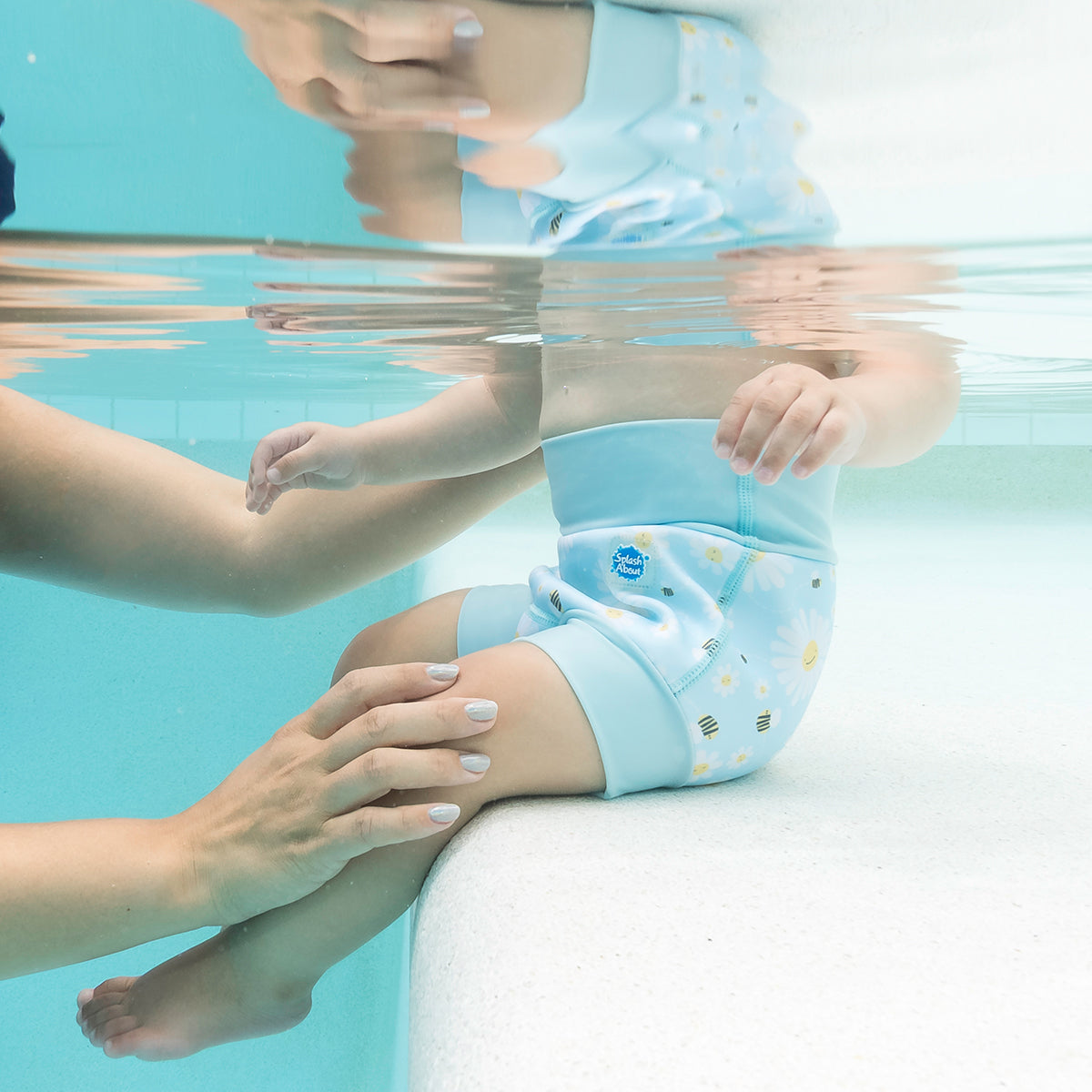
What does matter: get a swim nappy on before your child gets in the water, if they're still in nappies. A regular nappy absorbs pool water, swells and pulls down. That's uncomfortable and unsafe, and most pools won't allow it. The Happy Nappy™ is designed to contain faeces and prevent leaks into the pool, which is why 90% of UK swim schools insist on one for younger children attending lessons.
A weekly lesson you actually attend beats two lessons a week you keep missing.
”Why Weekly Beats Cramming Two In
Think of a weekly habit as building up, not repeating. Each session should feel a little lighter than the last, as your child's confidence stacks on what came before. Doubling the sessions in a week doesn't double that confidence. Your child's brain needs the gap between lessons to turn a new skill from something they're concentrating hard on into something they just do. Skip the gap and you skip the part where the skill actually sets.
What Is the 80/20 Swimming Rule?
Some coaches use it as a rough guide: about 80% of a session on technique and confidence, 20% on harder, more demanding drills. For young children in weekly lessons, that split tips even further towards the 80% side. Comfort in the water has to come first. If a teacher spends a whole 30-minute Stage 1 or 2 session on submerging, blowing bubbles and floating, they're not going slowly. They're building the foundation everything else sits on.
Skip the gap and you skip the part where the skill actually sets.
”Is Swimming Three Hours a Week Enough?
For a child in weekly lessons, three hours a week is well beyond what most families manage or need. A single 30-minute lesson a week, attended consistently over a school year, takes most children through several Swim England stages. Three hours becomes relevant once your child is swimming competitively or training with a club, and by then lessons have already done their job. For everyone else, weekly and consistent beats occasional and intensive, even in a busy month when lessons feel easy to skip.
How Long Does It Take to Learn to Swim?
Most children need somewhere between one and two years of steady weekly lessons to become a confident, independent swimmer, and longer still to get through the full Swim England Learn to Swim Stages 1 to 7.
Progress rarely runs in a straight line. Expect fast gains in the first few months, as new skills arrive weekly, then a longer stretch where it's harder to spot week to week. That plateau is normal.
What Level Should a 7 Year Old Swimmer Be At?
There's a wide normal range here, and it's worth relaxing into that range rather than comparing against a classmate or a cousin. Starting age and lesson consistency both matter more than age alone. A seven year old who started at four and has attended weekly without long gaps is often through the early Stages and working on full-stroke technique.
One who started more recently might still be building basic water confidence, and that's simply a different starting point. Ask your child's swim teacher where they sit against the Stage criteria directly. It's a far more useful measure than age.
When Is Twice a Week Worth It?
A few genuine reasons to add a second session:
Before a family holiday, a block of daily or twice-daily lessons over a week can build water confidence fast for the trip. That's a short-term goal, not the same as building strokes over time, and it suits the format well.
Has your child's progress stalled for months, not just the usual week-to-week plateau? A second weekly session can help, on your swim teacher's advice.
And once a child moves from Learn to Swim into a competitive or club stream, training simply happens more often as part of that different programme.
Outside those situations, twice a week rarely buys the extra progress it seems to promise. It costs something real, too: swimming becomes another scheduled commitment rather than something your child looks forward to. Enjoyment is what keeps children in lessons long enough to actually finish the Stages.
When Should Children Stop Swimming Lessons?
Water confidence isn't the same thing as water competence.
”Not as soon as they can swim. Water confidence isn't the same thing as water competence. A child who can manage 25 metres unaided in a warm, clean pool isn't necessarily safe in cold, moving water, in clothing or in a current. Swim England says children should stay in lessons until they've finished Learn to Swim Stages 1 to 7, at a minimum. For most families on a weekly rhythm, that means lessons carry on well past the point where your child first looks like a "swimmer" to you at the poolside.
Ask yourself whether your child is still enjoying it, and give that answer real weight. That's a more useful question than whether they can stop now. If they dread the weekly lesson, talk to their teacher about what's going wrong. Disliking one particular skill or class dynamic is usually fixable, and it's worth the conversation before you make any bigger decision.

What to Pack for Weekly Lessons
A weekly habit is easier to keep up when the kit doesn't need sorting out every Saturday morning. Our Floatsuit uses a 16-piece float system, and you take pairs out as your child's confidence grows through the Stages. It mirrors exactly how a weekly lesson plan works: support goes down step by step, not all at once. For younger starters, the Early Years Swim Vest gives simpler, belted support, and older children moving faster through the Stages tend to move up to the Adjustable Swim Vest. Keep a Kickboard in the swim bag too, for the kicking practice a teacher will often set as homework between sessions.
Still working out which piece of kit suits your child's stage? Our guide to Learn to Swim Floatsuits and our guide to Float Jackets & Swim Vests go through the differences in more detail.
If you're not sure whether weekly or twice-weekly makes more sense for your child, raise it directly with their swim teacher. They can see the Stage progress you can't always judge from poolside, and most are happy to talk it through with you.