
Your complete Guide to Floatsuits for Toddlers and Kids
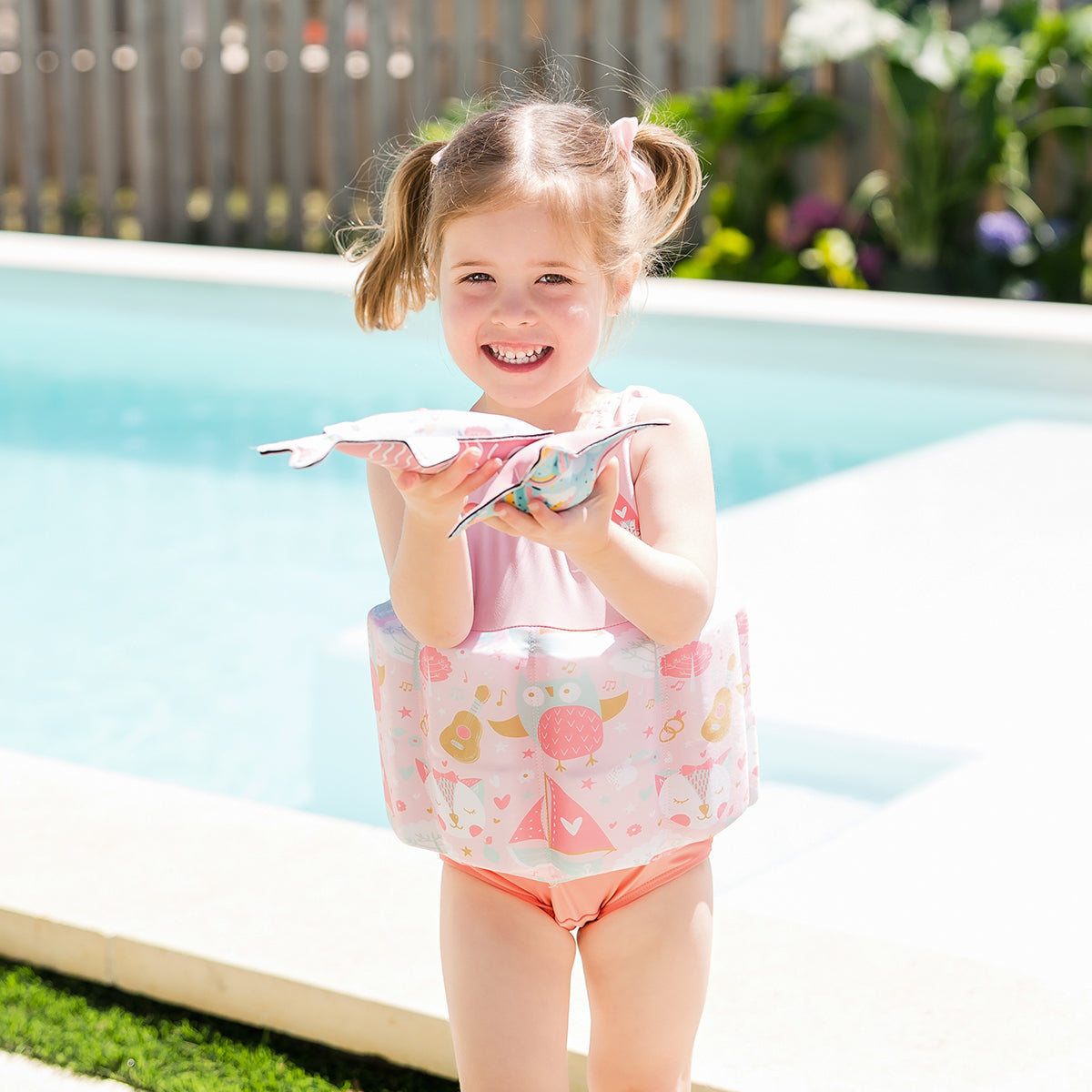
Floatsuits are swimming costumes with the floats built in, and for a lot of families they're the gentle first step that finally replaces armbands.
Estimated reading time 8 minutes
If you've got a one-year-old who pulls their armbands off at the poolside, or a four-year-old who's nearly swimming but not quite, a floatsuit holds them safely in a proper swimming position while you take the support away a little at a time, at whatever pace suits them.
Every child gets there in their own time, and it's completely normal to have questions along the way. Here's everything parents and carers ask us, answered as simply as we can.
In this guide:
- What are floatsuits?
- Comparing floatsuits & float jackets
- Best floatsuits
- How to care for floatsuits
- Floatsuits vs armbands
- Floatsuit FAQs
What are floatsuits?
A floatsuit is a swimming costume and a swimming aid in one garment. Foam float bars sit in pockets around your child's tummy and back, so the buoyancy surrounds the core of the body rather than hanging off the arms.
Our floatsuits hold a child tipped slightly forwards with their shoulders just under the water, which is the position a swimming teacher is trying to get them into anyway. Their arms stay free to paddle, and because the floats are zipped inside the suit, your child can't pull them off halfway through a session.

How do the removable floats work?
Each suit takes 16 float bars, held in pairs in front and back pockets. As your child gets more confident, you take out one bar from a front pocket and the matching bar from the opposite back pocket, always two at a time, so the suit stays balanced.
There's no right timetable for this, so try not to rush it. Some children are ready to lose a pair every few sessions; others feel happier with the full set for a whole summer, and both are perfectly fine. Detailed instructions come with every suit, and if a bar goes missing in the changing room you can buy replacement float bars individually.
What age can children wear a floatsuit?
From one year old up to six. Under one, babies don't usually have the balance or core strength to stay upright in a floatsuit, so they tend to tip forwards or backwards.
Don't worry if the same happens with an older baby or toddler on their first few wears; it's very common. If it does, start with fewer floats and add them back two at a time until they settle in that tipped-forward position without rolling. Then hold both their hands in front of them and steady them until they find their balance, which can take a few attempts, so go gently and let them enjoy the water while they work it out.
How do I choose the right floatsuit size?
Go by your child's body, not their birthday. Our floatsuits come in 1 to 2, 2 to 4 and 4 to 6 year sizes, but a tall two-year-old and a small three-year-old can need the same one, so measure chest, body length and weight against our size guide. If they're between sizes, give us a call before you order and we'll happily help you pick.

Comparing floatsuits & float jackets
The biggest difference is how finely you can reduce the support. A floatsuit comes down in eight steps of two bars; the Go Splash Float Jacket has eight floats in total, and the Go Splash Swim Vest has floats that don't come out at all.
Here's how the four line up:
| Floatsuit | Sleeved Floatsuit | Go Splash Float Jacket | Go Splash Swim Vest | |
|---|---|---|---|---|
| What it is | Swimming costume with floats inside | Floatsuit with arm, leg and neck coverage | Jacket worn over swimwear | Vest worn over swimwear |
| Adjustable floats | 16 bars, removed in pairs | 16 bars, removed in pairs | 8 floats | Fixed, not removable |
| Fabric | Chlorine-resistant, UPF 50+ | Nylon and elastane, UPF 50+, blocks wind and sand | Soft neoprene, keeps the chest warm | Neoprene that won't chafe, even when wet |
| Sizes | 1 to 6 years | 1 to 6 years | 1 to 3 and 3 to 6 years | 2 to 4 and 4 to 6 years |
| Designs | Girls' designs | Designs for boys and girls | Unisex | Unisex |
| Best for | Learning to swim at the pool | Outdoor pools, beaches and holidays | Cooler pools, wearing over their own costume | Packing flat for travel |
Notice that only the two floatsuits let you take support away in small, even steps, which is why we point parents of complete beginners towards them first.
When is a float jacket the better choice?
When the pool is chilly or your child already has a costume they love. The Go Splash Float Jacket zips on over any swimwear, and its neoprene keeps warmth around the chest, which matters for small children who get cold quickly in a learner pool.
The Go Splash Swim Vest is the holiday pick. It folds flat in a suitcase, an adjustable anti-rise strap stops it riding up in the water, and with fixed floats there's nothing to lose or put back in the wrong pocket, though it also means the support never reduces. A child who is close to swimming unaided will get more from a floatsuit or the Float Jacket. You'll find both jackets alongside our other float jackets and swim vests.
Best floatsuits
We make two floatsuits, and both use the same 16-bar float system. The choice comes down to how much of your child you want covered and where you'll be swimming.
The Floatsuit
Our original Floatsuit is a classic swimming costume cut, made from chlorine-resistant UPF 50+ fabric and currently available in girls' designs such as Over the Rainbow. It's the one for weekly lessons and family sessions at an indoor pool, where sun isn't a concern and you want the lightest suit on.
One parent wrote in a review that their daughter's confidence grew so quickly that "eventually no floats required and she's confidently swimming at the age of 5."
The Sleeved Floatsuit
The Sleeved Floatsuit adds coverage over the shoulders, neck, arms and legs in a nylon and elastane fabric that gives UPF 50+ sun protection and keeps off wind and sand. It comes in designs for boys and girls, including Sea Life and Tug Boats, with a quick-change zip at the back.
This is the suit for outdoor pools and beach holidays. Another parent called it indispensable on holiday with their three-year-old, adding that after trying several alternatives with older children, "this one is by miles the best." If you're heading somewhere sunny, the Sleeved Floatsuit and Legionnaire Hat bundle covers the back of the neck too.
Which floatsuit should I buy?
If any of your swimming happens outdoors, buy the Sleeved Floatsuit. A morning at an outdoor pool in a British summer is plenty to burn small shoulders, and the extra fabric costs your child nothing in movement. Choose the original Floatsuit if your daughter swims indoors and you'd rather she wore a lighter costume. For boys, the Sleeved Floatsuit is the one we make.
How to care for floatsuits
Rinse it in cool water after every swim and let it dry naturally out of direct sunlight. Our floatsuits are made from chlorine-resistant fabric, but chlorine and salt left to sit in any swimwear will shorten its life, so the rinse matters more than the wash.
Can I put a floatsuit in the washing machine?
Check the care label on your suit first. Whatever you wash it with, skip the fabric conditioner, because it can damage the UPF fabric that gives the suit its sun protection.
Should I take the floats out to dry it?
It helps. Taking the bars out lets the pockets dry properly, and it's a good moment to count them, since a bar that's gone missing on one side leaves the suit unbalanced. Put them back in matching front and back pairs before the next swim.
How do I look after the zip?
Keep sand out of it. Grains work into the teeth on beach days and slowly wear them down, so rinse the zip through with fresh water and check it for sand after every trip to the coast.
Floatsuits vs armbands
For learning to swim, a floatsuit does the better job, because it supports the body in a swimming position instead of lifting the arms. Armbands keep a child afloat by raising their arms out of the water, which pulls them upright and makes a natural stroke much harder to find.
Here's how they compare:
| Floatsuit | Armbands | |
|---|---|---|
| Swimming position | Tipped slightly forwards, arms free | Upright, arms held up |
| Adjusting support | Remove float bars two at a time | Fixed, unless you use a float disc system |
| Can your child take it off? | Not easily, floats are zipped inside | Yes, and young children often do |
| Sun protection | UPF 50+ fabric, full coverage on the Sleeved Floatsuit | None |
| Comfort | Soft fabric, arms move freely | Plastic can chafe the upper arm |
| Wear and tear | No air to lose | Can puncture or slowly deflate |
Notice that the two rows parents worry about most, a child pulling their aid off and an aid going down mid-swim, both favour the floatsuit.
Are armbands ever the better choice?
Yes, in a couple of situations. They're quick to grab for a casual splash when you're not trying to teach anything, they cost less than a floatsuit, and they come in sizes for children well past six. We sell armbands for exactly those days. If your goal is a child who swims on their own, though, start with a floatsuit, because the position it teaches is the one they'll keep once the floats come out.
Floatsuit FAQs
Are floatsuits safe?
Yes, as a swimming aid, used with you right beside your child. A floatsuit works with your child's natural buoyancy and stops them sinking, but it won't turn them the right way up if they get into difficulty, and it won't hold their head above water the way a life jacket does.
That's why the most important safety feature is you: stay within arm's reach, ideally one adult to one child, and never use a floatsuit in place of a life jacket on a boat or for watersports. Our floatsuits are CE tested to the European safety standard for swimming aids, and pools set their own rules on how many children each adult can supervise, as the National Water Safety Forum's guidance for parents and pools explains. It's worth checking yours before your first session.
Can my child wear a floatsuit with armbands?
No. Together they give too much buoyancy, which can be dangerous, so the armbands come off before the floatsuit goes in the water.
Can my child wear a floatsuit with a swim nappy?
Yes, and if they aren't potty trained they need one underneath. A floatsuit isn't designed to contain anything, so a Happy Nappy™ goes on first to contain faeces and stop leaks into the pool. Our guide to swimming nappies covers how to fit one.
What can my child use after the age of six?
Our floatsuits, float jackets and most of our swim vests are sized up to six. If your child still wants some support after that, the Adjustable Swim Vest is made for ages 6 to 10. Whichever vest you choose, check the fit before you get in the pool: it should sit snugly without leaving deep red marks. If they’re ready to practise without wearing their buoyancy, a kickboard lets them work on their kick while holding on.
What if my child won't wear a floatsuit?
Let them choose the design. A child who picked the tug boats or the sea creatures themselves usually feels much happier stepping into it, because it's theirs.
It also helps to let them try it on at home first, so it feels familiar before the pool. Most children find a floatsuit less restrictive than armbands once it's on, and there's only one thing to put on rather than a costume plus a float to hold. If today isn't the day, that's fine too; leave it and try again next swim.
Still not sure which floatsuit is right?
Every swimming journey looks a little different, and there's no prize for taking the floats out first. For most little ones starting out, a well-fitted floatsuit and a patient adult beside them, with the bars coming out a pair at a time, is all it takes to build real confidence in the water.
If you're unsure about sizing, or whether your child is ready for a floatsuit at all, get in touch with our team and we'll always be happy to help you find the right one. You can also browse the full range of floatsuits and see every current design.


